
- Discovery Assays

Human

Mouse
Rat
Porcine
Canine
Equine
Sheep
Bovine

Chicken
- Custom Plex Assays

Human
Mouse
Rat
Porcine
Canine
Equine

Sheep

Bovine
Chicken
- My Account
-





















Cytokine Testing for Clinical Trials: Multiplex Biomarker Support for Early Phase Studies
Early phase clinical trials often need more than standard safety data. In Phase 0, Phase I and Phase II studies, sponsors, CROs and research teams may also need to understand how a treatment affects immune activity, inflammation or disease related biological pathways. Cytokine testing for clinical trials can support this work by helping researchers measure immune and inflammatory responses as exploratory biomarkers.

This is especially important in early clinical development, where study teams are often working with small participant groups, limited sample volume and carefully controlled budgets. NIH describes Phase I trials as studies that test a drug or treatment in a small group of people, usually 20 to 80 participants, to learn about safety and side effects. NIH describes Phase II trials as studies in larger groups, usually 100 to 300 participants, to evaluate effectiveness and continue safety assessment (1). Cancer Research UK also describes Phase 0, Phase 1 and Phase 2 as early phase trials that usually focus on safety and side effects (2).
How Cytokine Profiling Supports Early Phase Trial Decisions
Cytokines, chemokines, and other soluble biomarkers can provide valuable translational insight during early phase drug development. In immuno-oncology, vaccine development, inflammatory disease research, and other immune-focused programs, cytokine profiling is commonly used to evaluate immune activation, pharmacodynamic effects, inflammatory signaling, treatment response patterns, and potential safety-related biological activity.
Early biomarker datasets can help research teams assess key translational questions, including:
- Is the therapy modulating the intended biological pathway?
- Are inflammatory signaling patterns changing following treatment?
- Are there early pharmacodynamic signals supporting the proposed mechanism of action?
- Which biomarkers may be informative for later-stage development?
- Can broader immune profiling inform future study design or biomarker strategy?
For example, increases in pro-inflammatory cytokines following dosing may indicate immune engagement, while suppression of inflammatory mediators may support anti-inflammatory or immunomodulatory activity depending on the therapeutic mechanism being studied.
Multiplex cytokine assays are particularly valuable in these settings because they allow multiple biomarkers to be measured simultaneously from relatively small sample volumes. This can be especially important in early clinical studies where sample availability is limited or where repeated longitudinal collections are required.
Preclinical and Clinical Development Considerations
Multiplex cytokine profiling is also widely used during preclinical development, where exploratory immune monitoring in animal models may support target validation, dose selection, and translational biomarker strategies prior to clinical testing. These exploratory datasets can help identify biomarker patterns that warrant further evaluation as programs advance toward clinical development. In preclinical settings, RUO (Research Use Only) assays are commonly used for exploratory immune profiling applications.
As therapeutic programs progress into clinical development, biomarker strategies may require more rigorously controlled assay platforms to support reproducibility, longitudinal interpretation, and study-specific regulatory expectations. Depending on study objectives and intended data use, clinical biomarker testing may therefore be performed using analytically characterized, validated, or CLIA-regulated assay workflows.
Broader Immune Context and Operational Support
Rather than evaluating individual biomarkers in isolation, multiplex cytokine profiling can provide broader biological context across complex immune signaling networks. When integrated with clinical and translational datasets, multiplex biomarker strategies can support more informed interpretation of treatment-associated biology throughout early-stage therapeutic development.
Outsourcing cytokine testing can also help research teams reduce the operational burden associated with establishing multiplex biomarker workflows internally. Rather than investing in specialized instrumentation, assay optimization, staff training, and ongoing workflow support, samples can be analyzed through an experienced biomarker testing laboratory with established multiplex capabilities.
Eve Technologies provides multiplex cytokine and biomarker testing services to support both preclinical and clinical research programs, helping teams generate high-quality biomarker data without building and maintaining complex assay infrastructure in house.
Multiplex Assays: High Content Testing for Limited Samples
Limited sample volume is a common challenge in early phase clinical studies. Researchers may need to evaluate multiple biomarkers across repeated study visits while working with relatively small volumes of blood, serum, plasma, CSF, or other specimen types.
Multiplex cytokine assays help address this constraint by enabling simultaneous measurement of numerous biomarkers from a single sample. Rather than performing separate assays for each analyte, multiplex platforms allow broader immune and inflammatory profiling while conserving valuable study specimens.
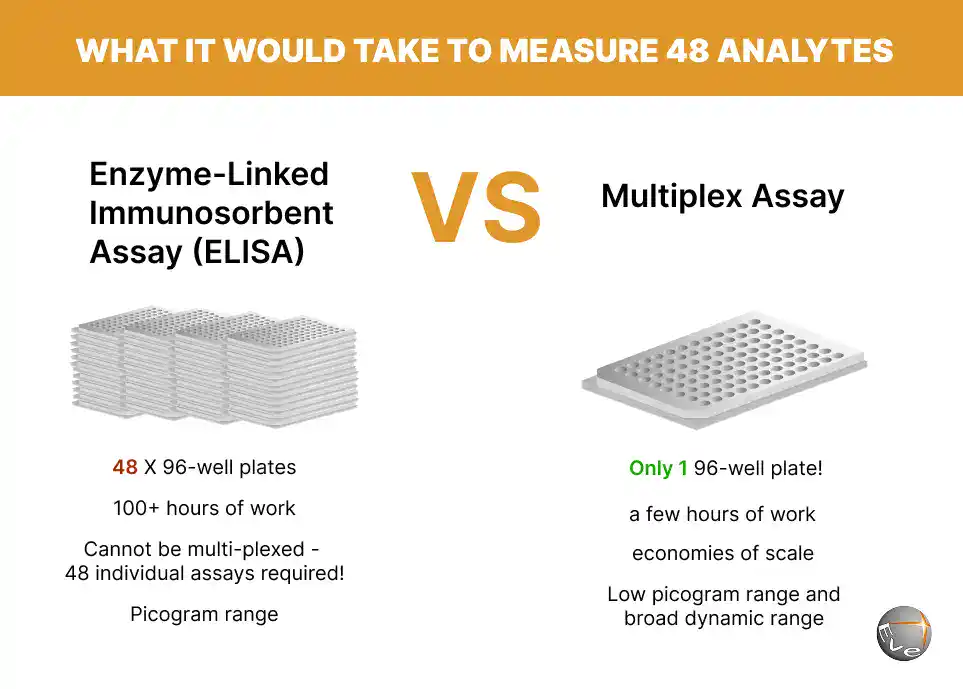
Compared with traditional ELISA approaches, multiplex platforms such as Luminex xMAP® and MSD® electrochemiluminescence assays support parallel measurement of cytokines, chemokines, and related biomarkers within a single assay. This approach can reduce sample consumption, minimize the number of individual assays required, and support longitudinal immune monitoring across early development programs (3).
Multiplex workflows are particularly valuable in translational and early clinical research settings where specimen conservation, broad biomarker characterization, and efficient study execution are important operational considerations.
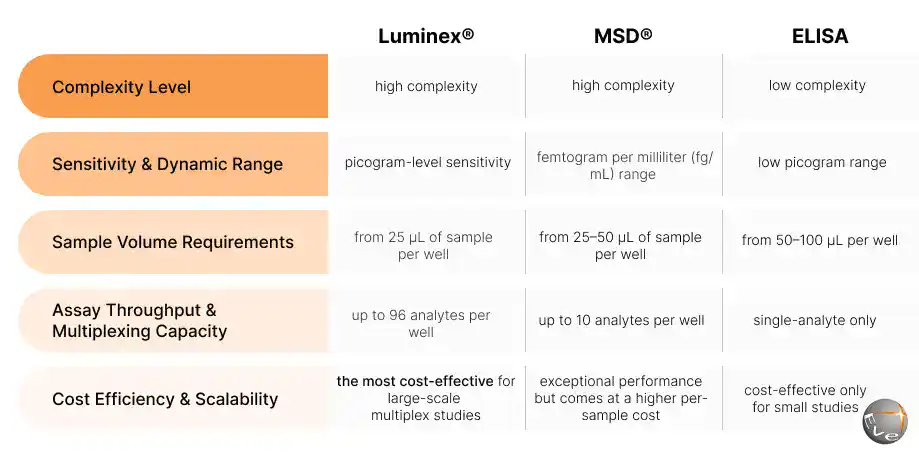
Traditional ELISA workflows typically measure a single analyte per assay. In studies requiring longitudinal evaluation of multiple cytokines or chemokines, running numerous individual ELISAs can increase sample consumption, operational complexity, and overall study burden.
Multiplex cytokine testing helps address these challenges by enabling simultaneous measurement of multiple biomarkers from a single specimen while supporting broader immune profiling from limited sample volumes.
This approach can be particularly valuable in early phase clinical studies where:
- Sample volumes are limited
- Multiple longitudinal collections are required
- Several cytokines or chemokines must be evaluated simultaneously
- Exploratory immune monitoring is incorporated into the study design
- Broader characterization of immune or inflammatory signaling is needed
Depending on the assay format selected, multiplex cytokine panels can support simultaneous measurement of dozens of biomarkers from a single serum or plasma sample. These datasets may help inform assessment of pharmacodynamic activity, immune engagement, dose-response relationships, and biomarker selection strategies for later-stage development.
Researchers interested in comparing Luminex®, MSD®, and traditional ELISA platforms can also review our multiplex assay comparison guide for additional information on assay formats, sample volume considerations, sensitivity, and translational study applications:
Multiplex Cytokine Assays Compared: Luminex®, Meso Scale Discovery®, and Traditional ELISA
Choosing the Right Lab for Cytokine Testing in Clinical Trials
When clinical trial teams look for a biomarker analysis lab, they are usually looking for more than a place to run samples. Selecting a biomarker testing laboratory for clinical or translational studies involves more than identifying a facility that can process samples. Early phase programs often require a laboratory partner with expertise in multiplex biomarker workflows, limited-volume specimen handling, and translational study support.
Important considerations may include:
- Relevant Assay Expertise
The laboratory should offer biomarker panels aligned with the study’s scientific objectives, including cytokines, chemokines, growth factors, inflammatory markers, and other immune-related analytes.
- Experience with Limited Specimens
Early phase and translational studies frequently involve limited or difficult-to-replace samples. This is particularly important in pediatric studies, serial sampling designs, rare disease programs, animal studies, or projects requiring multiple downstream analyses.
- Technical and Analytical Rigor
Successful multiplex cytokine testing requires more than instrumentation alone. Laboratories should have established expertise in assay optimization, calibration, quality control, sample handling, and biomarker data review.
- Scalable Operational Workflows
Some studies begin as exploratory pilot programs and later expand into larger cohorts. Laboratory workflows should support both small and large sample volumes while maintaining consistent analytical processes and turnaround expectations.
- Scientific and Pre-Analytical Support
Early collaboration can help research teams select appropriate biomarker panels, confirm specimen requirements, and minimize avoidable pre-analytical or sample handling variability before testing begins.
Why Outsource Multiplex Biomarker Testing?
For many academic groups, biotechnology companies, and CRO-supported studies, outsourcing multiplex biomarker analysis is often more practical than establishing these workflows internally. Developing in-house multiplex capabilities may require specialized instrumentation, trained personnel, assay optimization, ongoing maintenance, and quality oversight. Outsourcing can reduce operational complexity and allow study teams to remain focused on study execution, translational interpretation, and downstream development decisions.

Eve Technologies specializes in multiplex cytokine, chemokine, and biomarker testing for translational, preclinical, and clinical research applications. With more than 20 years of multiplex assay experience and a global client base spanning academia, biotechnology, and pharmaceutical development, our laboratory supports biomarker programs ranging from exploratory discovery studies through clinically regulated testing environments.
- Our assays and biomarker services have supported thousands of research programs worldwide and have been cited in more than 4,000 peer-reviewed publications.
In addition to RUO biomarker workflows, select multiplex platforms have also been implemented within CLIA-regulated laboratory environments to support translational and clinical applications. This includes HD95-Clin, one of the largest CLIA-regulated multiplex LDT cytokine panels currently available, designed to support high-content immune profiling within controlled clinical testing workflows.
Beyond assay execution, our team works closely with researchers to support biomarker strategy, study planning, panel selection, sample utilization, and translational interpretation throughout early-stage development programs.
How Eve Technologies Supports Cytokine Testing for Clinical Trials
Eve Technologies supports researchers, CROs, and clinical study teams with multiplex cytokine, chemokine, and biomarker testing designed for translational and early phase research programs.
Our multiplex biomarker workflows support both exploratory pilot studies and larger-scale clinical research programs, with broad immune and inflammatory biomarker coverage across established and custom assay panels. Researchers can select focused biomarker panels or develop customized multiplex configurations aligned with specific study objectives and translational strategies.
To support translational development workflows, assay options are available across multiple species including human, mouse, rat, pig, and canine models. This supports biomarker strategies spanning preclinical research through clinical development.
Our laboratory also supports low-volume specimen workflows commonly encountered in longitudinal and early phase studies, including serial collections, sample-constrained studies, and projects requiring multiple downstream analyses.
Prior to testing, our scientific team works directly with researchers to confirm specimen requirements, panel selection, and sample handling considerations to help support efficient study execution and minimize avoidable pre-analytical variability.
For exploratory biomarker studies, Eve Technologies provides RUO multiplex testing services. For programs requiring clinically regulated testing environments, Eve Diagnostics serves as our CLIA-certified clinical laboratory division supporting translational and clinical biomarker applications.
This approach allows study teams to access established multiplex infrastructure, translational biomarker expertise, and scalable laboratory support without the operational burden of developing and maintaining internal assay workflows.
Common Applications of Cytokine Profiling in Clinical Research
Multiplex cytokine and chemokine profiling is commonly incorporated into early phase and translational research programs to support immune monitoring, pharmacodynamic assessment, exploratory safety monitoring, and biomarker strategy development.
Common applications may include:
- Immune Monitoring in Immunotherapy and Vaccine Studies: Evaluation of treatment-associated immune activation and inflammatory signaling, including markers such as IFN-γ, TNFα, IL-2, and related cytokines involved in immune response pathways.
- Exploratory Safety Monitoring: Assessment of pro-inflammatory cytokines such as IL-6, IL-1β, and other inflammatory mediators associated with immune activation or cytokine release syndrome (CRS) in CAR-T, biologic, and immuno-oncology studies.
- Pharmacodynamic and Mechanism-of-Action Assessment: Evaluation of treatment-associated modulation of pathway-specific cytokines, chemokines, growth factors, or angiogenic markers following dosing.
- Translational Biomarker Strategies: Comparison of biomarker signatures observed in preclinical animal models with downstream clinical datasets to support translational interpretation across development stages.
- Investigator-Initiated and Exploratory Studies: Support for academic, rare disease, and early exploratory programs requiring broad immune profiling without establishing internal multiplex assay workflows.
When integrated with clinical observations and other translational datasets, multiplex cytokine profiling can provide additional biological context that may help guide biomarker selection, study refinement, and downstream development decisions.
Planning Cytokine Testing in Early Phase Studies with Eve Technologies
For early phase and translational studies, cytokine and biomarker testing strategies are often most effective when incorporated during protocol and sampling plan development rather than after specimen collection has already begun.
Early planning can help align assay selection, specimen requirements, collection schedules, storage conditions, and shipping workflows with the study’s biomarker objectives before samples are collected. This may help reduce avoidable pre-analytical variability and support more consistent downstream biomarker analysis.
Key planning considerations may include:
Biomarker and Panel Selection
Selection of focused or broad multiplex panels aligned with the study’s scientific objectives, pharmacodynamic hypotheses, and exploratory biomarker strategy.
Specimen Requirements
Confirmation of specimen type, matrix compatibility, collection tube requirements, sample volume, processing conditions, and storage considerations prior to study initiation.
Longitudinal Sampling Strategy
Planning for repeated collections across study visits while balancing biomarker coverage, specimen utilization, and downstream testing requirements.
Operational and Study Execution Considerations
Alignment of assay workflows, turnaround expectations, and study timelines to support efficient biomarker integration throughout the program.
Sample Handling and Shipping
Standardization of labeling, processing, storage, and shipping procedures to help maintain specimen integrity and reduce avoidable variability across collection sites.
Eve Technologies works with academic researchers, biotechnology companies, CROs, and clinical study teams to support multiplex cytokine and biomarker testing across exploratory, translational, and clinically regulated research environments.
Our scientific team supports researchers with assay selection, specimen planning, translational biomarker strategies, and scalable multiplex testing workflows spanning preclinical through early clinical development.
For studies evaluating cytokines, chemokines, or related immune biomarkers, early collaboration with an experienced translational biomarker laboratory can help support efficient study execution, specimen utilization, and biologically meaningful data generation throughout the development process.
FAQ: Cytokine Testing for Early Phase Clinical Trials
Does Eve Technologies support cytokine testing for clinical trials?
Yes. Eve Technologies supports multiplex cytokine, chemokine, and biomarker profiling across preclinical studies and early clinical development programs, including Phase 0, Phase I, and Phase II research. Our laboratory supports both exploratory RUO workflows and clinically regulated biomarker testing environments using established multiplex assay platforms and translational biomarker expertise.
Which study types commonly incorporate cytokine and chemokine profiling?
Multiplex cytokine profiling is commonly incorporated into preclinical and early clinical studies evaluating immune engagement, pharmacodynamic activity, inflammatory signaling, proof-of-mechanism endpoints, and exploratory safety-related immune responses.
These datasets may help research teams better understand treatment-associated biology throughout early-stage development programs.
Why are multiplex cytokine assays useful for preclinical and clinical samples?
Multiplex cytokine assays enable simultaneous measurement of numerous biomarkers from limited specimen volumes. This is particularly valuable in longitudinal studies involving repeated collections, limited sample availability, or broader immune profiling objectives.
Platforms such as Luminex® and MSD® support broader biomarker characterization while reducing sample consumption compared with multiple individual single-analyte assays.
Can research samples be sent to Eve Technologies for biomarker testing?
Yes. Research teams can submit prepared serum, plasma, CSF, tissue culture supernatants, and other validated specimen types for multiplex cytokine, chemokine, and biomarker analysis.
Our scientific team provides guidance regarding specimen compatibility, sample volume, collection conditions, storage requirements, and shipping considerations prior to study initiation and sample submission.
Does Eve Technologies support pilot studies and smaller exploratory programs?
Yes. Our multiplex workflows support investigator-initiated research, pilot studies, translational biomarker programs, and larger clinical research projects. Routine Discovery Assays do not require minimum sample numbers, allowing flexibility across exploratory and longitudinal study designs.
Does Eve Technologies provide research or clinically regulated testing services?
Eve Technologies provides RUO multiplex biomarker testing services for exploratory, preclinical, and translational research applications. For programs requiring clinically regulated testing environments, Eve Diagnostics serves as our CLIA-certified clinical laboratory division supporting translational and clinical biomarker applications, including HD95-Clin, a high-content CLIA-regulated multiplex LDT cytokine panel.
With more than 20 years of multiplex assay experience, a global research client base, and biomarker services cited in more than 4,000 peer-reviewed publications, our team supports biomarker programs spanning exploratory discovery through clinically regulated testing workflows.
References
- National Institutes of Health. The Basics: NIH Clinical Research Trials and You. https://www.nih.gov/health-information/nih-clinical-research-trials-you/basics
- Cancer Research UK. Phases of Clinical Trials. https://www.cancerresearchuk.org/about-cancer/find-a-clinical-trial/what-clinical-trials-are/phases-of-clinical-trials
- Eve Technologies. Multiplex Cytokine Assays Compared: Luminex®, Meso Scale Discovery®, and Traditional ELISA. https://www.evetechnologies.com/multiplex-cytokine-assays-compared-luminex-meso-scale-discovery-and-traditional-elisa/
- Eve Technologies. Multiplex Biomarker Profiling. https://www.evetechnologies.com/multiplex-biomarker-profiling/